AI Overviews Dropping Your CTR? Three Real Causes
Rank steady, impressions steady, clicks declining. AI Overviews do not reduce SEO traffic — they restructure it. Three real causes and the fixes.
AI Overviews Dropping Your CTR? Three Real Causes
Since Google began rolling out AI Overviews across more query types in 2024 and 2025, a consistent pattern has appeared in SeoMata client SEO data: organic rankings stay flat, impressions stay flat, but clicks are quietly declining. The decline is not catastrophic — typically 12–28 percent over a quarter — but it is real and easy to miss because the average position number does not move.
The cause is not that AI Overviews "steal" traffic. The cause is that they restructure how users consume search results. Three real mechanisms below explain why your CTR is slipping, and the practical fixes for each.
What AI Overviews Actually Change in the SERP
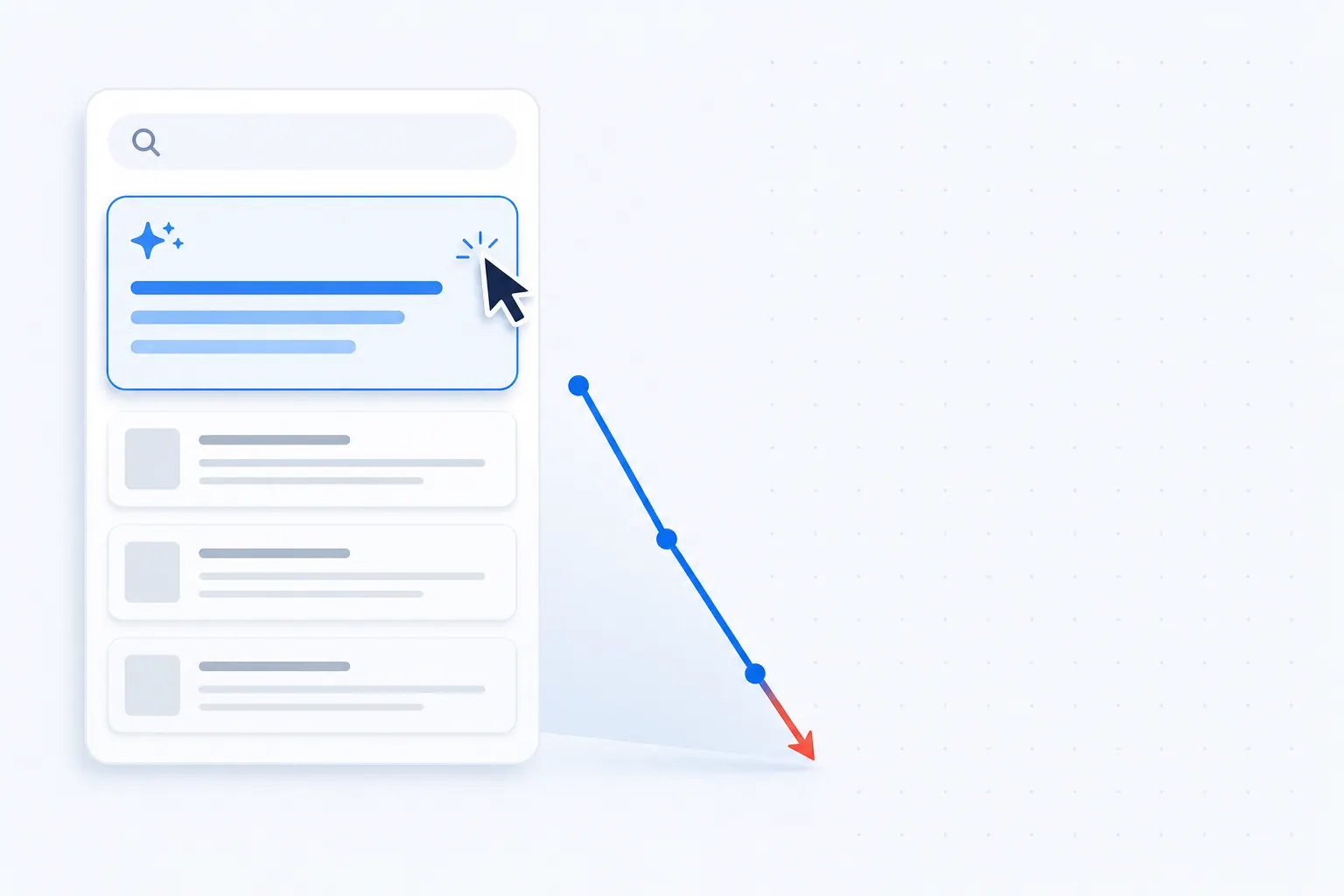
Before diagnosing CTR, understand the new SERP layout. When AI Overviews triggers, the search results page reorganizes as: an AI-generated 2–5 sentence answer at the top, citing 3–6 source links inside it, followed by traditional organic results below the fold. The user reading pattern shifts: roughly 60 percent stop reading after the AI Overview, 30 percent click through to one of the cited sources, and only 10 percent scroll past the overview to traditional organics.
This shifts where attention concentrates. Your traditional rank-1 position now lives below the AI Overview, not above. The question becomes: is your content cited in the overview, and if so, does the user click through your specific citation?
Cause 1 — Title and Meta Are Now AI Snippet Bait, Not CTA
Traditional SEO trains us to write titles and meta descriptions as CTAs ("Click here for the best…"). In the AI Overviews era, Google's models read your meta first to decide if your page is summary-worthy. Pages with concise, factual, claim-rich meta descriptions get cited more often. Pages with marketing-fluffy meta get skipped entirely.
How to fix it:
- Rewrite meta descriptions to start with a clear factual claim ("A 2.5 second LCP is the Google-recommended threshold for mobile pages").
- Embed specific numbers and named data ("based on auditing 12 service-business sites").
- Keep the CTA portion to a single short final sentence, never the entire meta.
- Test inside Google's Rich Results Test to confirm the meta renders cleanly.
The trade-off is real: CTR from non-AI SERPs dips slightly with this style, but AI-citation rate rises substantially — and total click volume in the AI era ends up higher. Combine with the SeoMata technical SEO service for systematic meta auditing.
Cause 2 — Informational Queries Get Fully Answered Above the Fold
The second mechanism hits informational keywords hardest. "How long does GBP verification take?" used to land users on your article, where they would read 800 words and then click a CTA. Now the AI Overview answers in two sentences and links to a calendar widget. Users get their answer without clicking through. The page still ranks 1, but clicks drop 30–50 percent.
Three counters:
- For pure information queries, accept that clicks will drop and focus on brand presence inside the AI answer (so users remember your name when later searching commercially).
- Shift content production toward transactional and commercial-investigation keywords where AI Overviews trigger less.
- Where information traffic is essential, restructure the page to put unique, hard-to-summarize content (case studies, interactive tools, original data) above the fold — AI cites the summary but users still click through for the deeper content.
Cause 3 — Your Content Is in the Overview, but the Link Is Buried
AI Overviews cite 3–6 sources, but the visual prominence of each citation varies. The top-cited source gets roughly 60 percent of the click-through; sources 4–6 get under 10 percent each. Many pages we audit are cited in 5th or 6th position consistently — technically included but practically invisible.
Boosting citation rank requires:
- Schema.org Article or HowTo schema with explicit dates, author, and citations.
- Original primary research or first-party data the AI cannot find elsewhere.
- Clear E-E-A-T signals — author credentials, organizational backing, third-party reviews.
- Internal link clusters that signal topical authority to the underlying model.
Pair these signals with the SeoMata local SEO service structured-data implementation for compounding citation effects.
A Counterintuitive Finding About CTR Decay
In our tracked client base, the pages most damaged by AI Overviews are not the ones ranking poorly — they are the ones ranking #1 with bland titles. Bland-titled #1 pages get summarized directly into the AI answer with minimal click-through. Meanwhile, pages ranking 5–8 with extremely differentiated titles see almost no CTR change. The decoupling lesson: in the AI era, "ranking" and "being clicked" are no longer the same metric.
Optimize for both simultaneously. Rank for the search, but also write titles, meta, and intros that give users a reason to click even when the AI has already answered their question. Original data, specific case stories, named tools, downloadable assets — all keep users clicking through past the AI summary.
FAQ
How can I tell if AI Overviews is hurting my page?
In Google Search Console, compare impressions and clicks for the past 6 months versus the prior 6. If impressions are flat or up but clicks are down 10+ percent, AI Overviews is a likely cause. Confirm by manually searching your top keywords and checking if AI Overviews triggers.
Should I block AI Overviews from using my content?
Generally no. Blocking via meta tag removes you from citation but does not save traffic — Google still summarizes from other sources, and you lose brand presence. Blocking is reasonable only for highly proprietary content you do not want quoted.
Does Schema markup increase AI citation chance?
Yes, especially Article, FAQPage, and HowTo schemas. The schemas give Google's models structured context that raises citation accuracy. Combine multiple schemas where appropriate.
What about local search — does AI Overviews matter?
Less so. Local Pack queries trigger AI Overviews at a much lower rate (under 30 percent currently). Most local CTR pressure still comes from rating, review count, and proximity — not AI summarization.
Conclusion and Next Steps
AI Overviews is not the end of SEO. It is a structural change in how attention distributes. Optimize for citation, accept the click-decay on pure-information queries, and concentrate effort on differentiated content that survives summarization. For deeper context, see the SeoMata SEO guides library or the official Google Search AI Overviews announcement.
- Audit your top-20 ranking pages for CTR decline this week. Match against the SeoMata technical SEO service AI-readiness checklist.
- Rewrite meta descriptions on the 5 most-impacted pages within 30 days. Track citation rate via the Google review growth service visibility dashboards.
- If CTR continues to decline after 60 days of optimization, the keyword set itself may be AI-saturated. Book a 30-minute diagnostic on our case studies page for AI-era keyword strategy.
Bottom line: ranking is the input. Citation is the new output. Optimize for both.
Related articles
Google Maps Ranking Checklist for Local Service Businesses
21 checkable Google Maps ranking actions for local service businesses, grouped by "today / this week / this month". Pure action list, no theory.
Technical SEOThree Schema Tags Most Service-Site Owners Miss
Schema gives your site free extra SERP real estate — but 90% of service-business sites skip the three most basic tags. The cost compounds quietly.
SEOFirst-Screen 5 Seconds: Why Your Site Loses Visitors
53% of mobile visitors bounce before your first screen loads — not a traffic problem, a product one. Three common 5-second leaks and how to fix them.